
Understanding SLAM: Mapping and Positioning
Tech
The Core Technology for Indoor Spaces
What if robots or autonomous vehicles could explore unknown spaces while figuring out where they are? That's SLAM technology, a core capability for understanding indoor environments. Let's explore how SLAM relates to mapping and positioning.
What is SLAM?

SLAM stands for Simultaneous Localization and Mapping. It performs location estimation and map creation at the same time. Using sensor data in environments with no prior information, it builds a map of the surroundings while simultaneously determining its position on that map.
Imagine entering an unfamiliar room blindfolded, feeling along walls and furniture to understand the layout while figuring out where you are.
Mapping: Creating a Digital Twin

Mapping generates a digital map of physical space based on sensor data.
Accurate mapping is critical in complex indoor environments like hospitals or smart factories. Sensors including LiDAR, cameras, and IMUs combine their data to build 2D or 3D maps. These maps become the foundation for services like asset tracking, navigation, and spatial analysis.
Positioning: Real-Time Location Estimation
Positioning estimates your location in real time on maps created through mapping.
SLAM-based positioning works with minimal infrastructure investment. Devices calculate their position by comparing sensor data collected during movement against the map. This makes it useful in dynamic environments or spaces where installing infrastructure is difficult.
The Circular Structure of SLAM
In SLAM, mapping and positioning need each other. Creating an accurate map requires accurate location information, and knowing your location requires an accurate map. SLAM algorithms iteratively improve both processes to solve this.
Modern SLAM uses probabilistic approaches to handle uncertainty. Through techniques like particle filters, Kalman filters, and graph optimization, the technology manages sensor noise and environmental changes.
Current Limitations
SLAM is applied far beyond robotics in indoor positioning. However, because it typically relies on camera vision or LiDAR, challenges remain.
High Cost:
Industrial LiDAR sensors cost tens of thousands of dollars, and vision systems require substantial investment. This creates barriers for companies deploying SLAM in large spaces.High Computational Complexity:
Processing massive real-time data from cameras or LiDAR requires significant computational resources, becoming a major constraint for battery-limited mobile devices or small robots.Sensor Dependency:
SLAM performance depends heavily on sensor quality and type. Vision-based SLAM struggles in dim lighting, and accuracy drops in environments with few distinctive features like glass walls or long corridors.Accumulated Error:
Small measurement errors accumulate over time, causing map distortion or location errors. Loop closure techniques help, but challenges remain in large or complex spaces.Difficult Initial Setup:
SLAM systems need sufficient initial feature points and accurate initial maps to operate stably. Setup failures degrade overall performance.
RF-SLAM: Solving the Cost Problem
Digital twins generated through SLAM enable deep understanding of indoor spaces. While not perfect due to costs and complexity, SLAM adoption will expand in future industries.
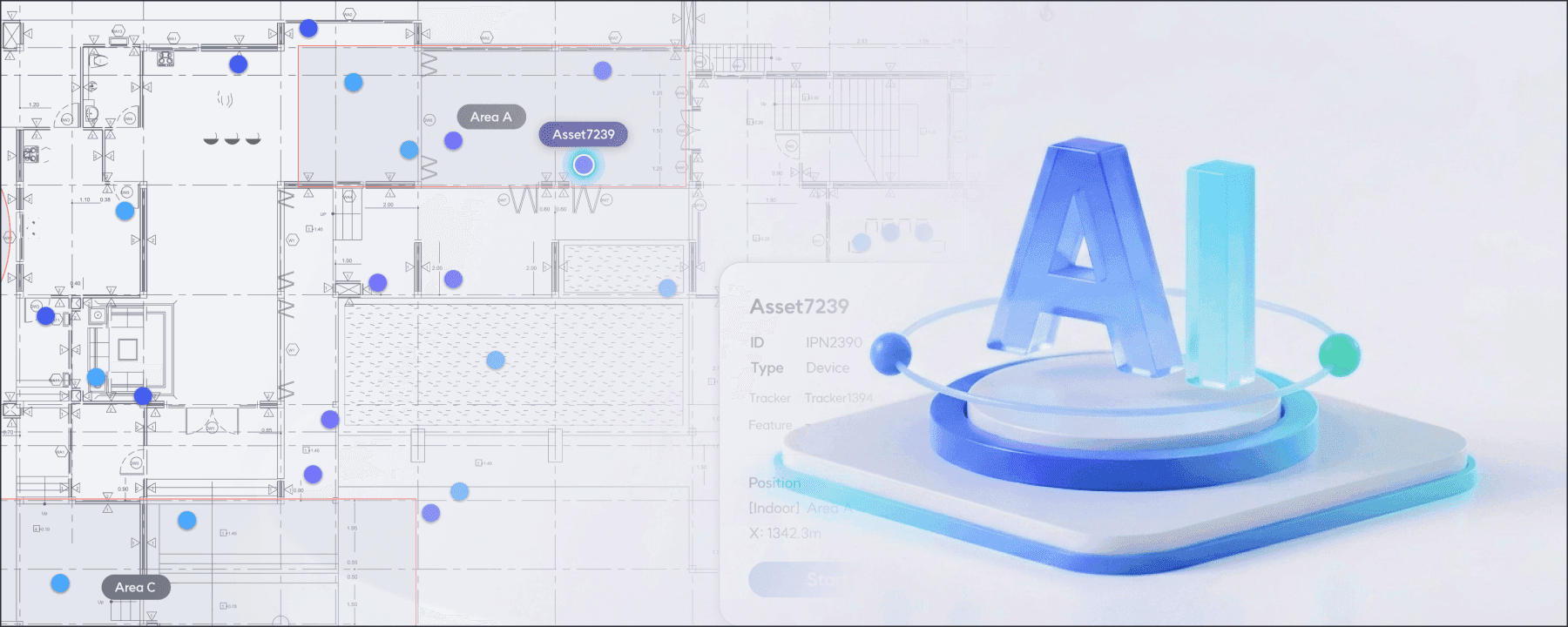
IPIN LABS developed deep learning-based RF-SLAM technology to solve traditional SLAM's cost problems. Instead of expensive LiDAR or cameras, it uses RF signals like Wi-Fi or BLE already installed in buildings, dramatically reducing investment and maintenance costs.
IPIN LABS maintains traditional SLAM's advantages while improving cost efficiency and practicality, making indoor positioning accessible to more companies.


Try Lite!